Thursday, June 22, 2006

T-Shirts, Pens, Mugs and Belt Buckles

It's not uncommon to see company promotional materials in the form of t-shirts, mugs and pens.

This is my first sighting of a new form of logoware: an imitation diamond-studded belt buckle. Perhaps the start of a new trend?


Wednesday, May 24, 2006

Not evil, but a pinch of deliberate confusion

I don't have any scientific evidence to back up a full-fledged assertion, but I have always suspected that a key success factor behind the simple text ads that comprise search marketing is their subtleness. They look just like natural search results, and I don't think most consumers actually understand the difference.

I run Google ads on my blog, and last month I received this note from Google:
We're writing to let you know about a coming change to the appearance of your Google ads. Your ads currently display the default Google color palette, Seaside (formerly known as Mother Earth). In the near future, we plan to update the default palette to Open Air, a new palette containing the same set of colors, but without the blue border. We've found that many publishers prefer the cleaner look of this palette and have also seen that a blended color palette performs better for them -- attracting user interest while still maintaining the distinction between ads and content with the 'Ads by Google' label.
Big deal, they changed the default colors. Actually it is a big deal -- they eliminated the blue border. Is it me or is this an attempt to further blur the line between content and advertisements? If we polled 1,000 random Internet users, how many really understand that text links are ads?

Evil? Probably not.

Deliberately confusing? Definitely.

Monday, May 15, 2006

Google's Iron

Until today, I didn't fully appreciate how aggressive Google had become with its desire to own datacenters around the world. Of course I have heard countless stories of the massive server farms Google operates. One rumor even suggested Google built a meaningful single digit percentage of all PCs last year.

Still, I was stunned to learn from a young New York based startup about its recent run-in with a hosting service provider (HSP). As background, this startup serves about 1.5 billion monthly page views out of its single datacenter in New York. That's a lot of data, which makes this company a reasonably attractive HSP customer.

A few months ago, its HSP informed the startup that it would not be able to add any more servers to its cage. There was plenty of physical space in the cage, but the HSP claimed it was out of power. There were not enough volts to power any additional servers.

At first, the startup figured someone at the HSP was going to be fired for making such a stupid miscalcuation. How could they not design the place with enough power to operate cages chock full of servers? It just didn't make sense... until they learned what was really going on.

Google had moved to town. It appears Google is trying to purchase as much datacenter capacity as it can find. It offered a certain New York City HSP so much money that the HSP started mistreating its own customers to get them to leave so Google's appetite could be satisfied.

Let this be a warning to other HSP customers around the globe -- beware the day that Google moves to town.

Monday, May 08, 2006

Giving good phone

Some people have such great phone voices that it's hard not to want to talk to them. A multi-hundred million industry emerged based on that observation. Marketers persuaded consumers to call 1-900 lines (often, though not always, for sex chat) and relied on their operators' ability to give good phone to keep consumers engaged as the bills ran up at the tune of $5 per minute.

Excellent reporters typically give good phone as well. They use the skill to keep their interview subjects engaged beyond the length of time it makes sense to spend talking to a reporter.

Of course sales executives are often blessed with (or develop?) this talent as well. People buy from people they like, and the first step toward liking someone is talking to them for a while. That's why giving good phone comes in quite handy in sales.

I think I give average phone. Not great, but not awful either. A new service from Ether is allowing me to test how good my phone is. I decided to reserve a short period of time during each of the next few weeks to dispense venture capital advice to people I don't know. I'm mostly curious to see if anyone will take me up on it, and if anyone does, I'll be sure to ask them if I give good phone.

I believe Ether handles all the billing and logistics, though I haven't tried it yet, so I'm not entirely sure. If $2.50 per minute doesn't scare you, give me a call. While I cannot guarantee satisfaction, I promise to talk fast.

JeremyVC
1-888-MY-ETHER ext. 01610091

Update: As a further inducement to potential callers, all proceeds will be donated to the East Harlem Tutorial Program.

Thursday, April 06, 2006

Scan Artist Population Continues to Grow

MIT Technology Review's Simon Garfinkel has announced he, too, is a Scan Artist. He has good taste in scanners. Welcome to the club, Simon.

Scan Artist Population Continues to Grow

MIT Technology Review's Simon Garfinkel has announced he, too, is a Scan Artist. He has good taste in scanners. Welcome to the club, Simon.

Saturday, March 18, 2006

Actually, It's Rupert's Third Try

Rupert Murdoch, the man behind News Corporation, has been both praised and ridiculed in the press for propelling his media empire onto the Internet with the acquisition of MySpace. Newsweek called it "Murdoch's New Groove" and the Techdirt headline mockingly shouted "All Hail Lord Murdoch of the Internet" as if to say he just discovered the Internet, and he's already declared himself king.

Regardless of whether you think News Corp's recent MySpace purchase was brilliant or idiotic, you have to hand it to Rupert Murdoch for his persistence. This is at least his third attempt to figure out what a media company should do online.

He was among the very earliest online pioneers with his 1994 purchase of Delphi Internet Services. That foray did not end well (Delphi eventually faded into obscurity), but Murdoch was obviously paying careful attention to the Internet before most of us even had an email address.

That first failure did not deter him. In early 2000, he purchased a significant equity stake in UpMyStreet, which is still one of the most clever local search sites online (unfortunately, it only works in the United Kingdom). UpMyStreet got caught by the trappings of the bubble and was out of cash by 2003. A cash-flow generating young upstart called USwitch.com acquired the assets and has operated UpMyStreet profitably ever since. The US media giant Scripps took notice and bought Uswitch for $366 million last week. Maybe Murdoch was, perhaps, just a bit too early.

Much more recently, News Corp. ventured back online with the purchase of Scout, a collection of online and offline local sports media properties, and MySpace. Many believe MySpace will fade just as quickly as it ascended from an idea to a top-10 Internet property. Though it is unclear whether Murdoch will ultimately regret his recent purchases, it is crystal clear that he has been thinking about and exploring Internet media for quite some time.

Monday, March 13, 2006

To Yahoo or Not to Yahoo

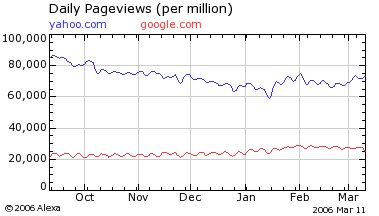
I use Yahoo every day. It is my Firefox homepage and accounts for more of my web traffic than does any other site on the Internet. I'm clearly not alone. According to this Alexa chart, Yahoo serves almost 3x as many pages as Google.

Seven years ago, I invested the time to customize a My Yahoo page and have incrementally added quite a bit to it since then. It has become my primary RSS aggregator, my sports and finance ticker and my first source of news. (I would even use it for web searches, but for some idiotic reason, the folks at Yahoo have not programmed the page to load with the search box in focus; as long as I have to make an extra click, I might as well click in Firefox's Google box.)

In a piece for Fortune last week, David Kirkpatrick warns Wall Street not to "stare so hard at Google you miss Yahoo." He highlights Yahoo's relatively cheap P/E ratio of 24x (including a bunch of one-time gains last year including the sale of some Google stock) when compared with Google's 67x . He argues that Yahoo is catching up to Google in terms of search quality and has made some smart moves to capitalize on social networking with its Flickr and Delicious acquisitions. He believes Yahoo will soon be considered Google's peer.

My hedge fund friend thinks otherwise. He questions Yahoo's future relevance entirely. His argument goes something like this: AOL was "stage one" of the Internet -- consumers did not even know how to get online in the early days, and AOL's sheltered dial-up service made it accessible.

Yahoo is stage two of my friend's "training wheels for the Internet" theory. As everyone learned to get online, they needed a place to go that conveniently aggregated their media content and introduced new services. Yahoo served that purpose.

In stage three, however, as consumers finally comprehend and master features like bookmarking and RSS aggregating, will Yahoo still have a purpose? Though I'm currently a devoted Yahoo user, I tend to agree with my hedge fund friend. This Alexa graph supports his theory:
In terms of reach, Yahoo is falling behind. The number of consumers relying on Yahoo the way I do is not growing. Google has overtaken Yahoo as the primary Internet home page, and as users like me find superior best-of-breed alternatives to replace the components of their My Yahoo pages, I suspect the flat blue line in the graph will trend downward.
Wednesday, March 08, 2006

A Helping of my Yelping

In this blog, I have focused on topics related to areas I think are ripe with innovation and, therefore, present fertile ground for venture investing. And I have rambled on about miscellaneous gadgets, technologies and anecdotes that have captured my imagination (or at least my attention). I deliberately shied away from referring to my Bessemer investments to prevent this from becoming a shameless promotional tool. I included the simple link to my investments in the right-hand column and left it at that.

Until now!

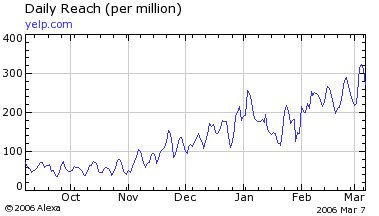
If you haven't already explored Yelp, now would be a good time to check it out. If you wait much longer, you'll qualify for luddite status, because the rest of the Internet population will have discovered it before you. This is what one might call a blog brag, but here is Alexa's summary of Yelp's recent traffic growth:
For investors, few things in life are more pleasing than graphs that go up and to the right.

So, why did I invest in Yelp, and what is it?

My investment in Yelp was an outgrowth of my interest in community-oriented, user-generated content, but I'll blog more about that later. Yelp solves what I call "the Citysearch problem." I used to love Citysearch. It showcased what other people thought about everything local -- stores, restaurants, dentists, auto mechanics, etc. But over time it became virtually impossible to find a negative review about anything. All the content read like it had been written by a close relative of the store owner.

Enter Yelp. Yelp reveals who is behind the opinions. It lets you determine whether you share the same sensibilities as each reviewer. And then you can discover other local establishments you otherwise might never have found. Instinctively, we all consult friends for referrals when we're in need of a new doctor, the right restaurant for a special date, or a trustworthy mechanic. Yelp adds the power and scale of the Internet to these word-of-mouth referrals.

Yelp is also trying to become a verb. To Yelp about something is to share one's opinions. Mine accumulate at jeremyl.yelp.com. I have also added a helping of my Yelping to the right-hand column of this blog. Yelp's nifty Maptastic feature plots my reviews on a Google map. You can tell I spend most of my time bouncing between San Francisco and New York.

Yelp's talented team managed to incorporate the user interface je ne seis quoi which makes some sites really slick and fun to use. When you sign up, click Member Search near the top right of the page to search for me and add me as a friend.

Wednesday, February 01, 2006

Infoworld Agrees with Me

In one of my blog postings from last September (here), I celebrated the arrival of a fabulous new Fujitsu desktop scanner. My colleague James Cham just pointed out that it took Infoworld an extra five months to make the same observation here.

Though meaningless in the scheme of things, it feels good to scoop the tech press.

Tuesday, January 17, 2006

Comics, topless women or math equations?

In today's New York Times, Nicholas Kristof's editorial outlines the race between China and India to become the world's leading power by the year 2100. He highlights India's demographic advantages (more working-age people) and financial system (China's banks are a mess). And he praises China's impressive infrastructure (India has third-rate roads and ports). In the end, he places his bet on China. His column-ending prediction is not particularly controversial, and besides, very few of us will be around to see if he made the right choice.

That said, his column will have a lasting effect on me because of the paragraph in which he points out a primary driver behind each country's emergence on the world stage -- an emphasis on education. Here is the paragraph that captures the essence (bold added by me) :

Most American newspapers lure readers with comics, and some British tabloids with photos of topless women, but a Calcutta daily newspaper is so shameless that it publishes a column on math equations. Imagine titillating readers with trigonometry!

Living in America where the average adult watches 1,600 hours of television per year, titillation with trigonometry really is hard to imagine.

Monday, January 16, 2006

Shorts and Longs (Digital Livingroom)

At last month's Digital Livingroom conference in San Mateo, my co-panelists (Tim Bajarin, Julie Ask, and Mike Langberg) and I were charged with outlining a "roadmap for the future" of the digital livingroom. I shared my views on these six ideas (three longs, three shorts) and asked the audience for its opinion on each. For what it's worth, they tended to disagree with me, but here are the calls I made.
  1. Every consumer electronics device (tvs, clock radios, etc) will be connected to the Internet.

    I'm LONG this idea. This is a great opportunity for hardware companies to get into the recurring revenue stream by selling services and content for their own devices or by charging a gatekeeper fee to others. They will need help with the software to make it all work as they've never had decent software capabilities, and of course Microsoft will try to dominate all these devices. Regardless, we will see networked CE products everywhere.


  2. Consumers will continue to pay $100/month bundled cable/content bills.

    I'm SHORT this one. First it will be just fringe content providers, but eventually even ESPN will want direct-to-consumer relationships. With a networked television, you will be able to sign up for a single content provider directly over the Internet. The cable company will provide a pipe and will still offer content bundles, but no one will be paying $100 per month for a boatload of channels they never watch.
  3. Mommy and grandma will soon be fighting with the teenage kids for Xbox time.

    LONG. It's going to be a different genre of games -- think Mahjong and Tetris. But with the Internet-connect consoles, new online communities will emerge. Business Week already wrote a story on the Gaming Grannies.
  4. We'll all be browsing the web in the kitchen.

    LONG but not in the usual sense. We won't be using a browser on a PC or terminal screen. We'll be looking at dedicated devices designed to communicate specific information. Maybe it's a refrigerator with a handle that changes color when it needs to be re-stocked. Or perhaps we'll have a coffee maker with a small embedded weather forecast display. I doubt all these devices will be using Ambient Devices' network, but I do think Ambient has the right design ideas.


  5. We'll consume our living room content "on the go" (a la Sling Devices).

  6. SHORT. We will consume content on the go, but it will be made for our small form factor portable devices. It will be short clips (3 minutes, not 30). Simple "copy and transmit" devices like Sling may be used to watch a PVR-recorded show in the office, but they won't cut it for mobile devices, on which we will watch purpose-built content.


  7. With all this precious content (digital photos, purchased digital music and movies) on our PCs, a backup server in the home like Mirra will become a must-have.

    SHORT. There is little doubt that backups will become critical as the cost of the content on our hard disks starts to dwarf the cost of the hard disk itself. However, copying content onto another hard disk in the house is not the best solution. Some version of the networked backup services that first emerged in the late 90s (remember the likes of X-Drive?) will return with their sharing and remote access features.


Saturday, January 14, 2006

Forget Dolby 7.1, Try 40-Channel Surround Sound

Many of my Bessemer colleagues went to the Consumer Electronics Show in Las Vegas earlier this month. I had attended it in each of the last several years but decided to skip this one. I was slightly disappointed with the small number of new things I saw in 2005 relative to 2004, so I decided to make it an every-other-year event.

Little did I know, my trip to the Museum of Modern Art last week turned out to be a decent substitute for CES. I didn't intend to get an electronics junkie's fix from MOMA, so I was surprised to find two exhibits that conjured up images of CES.

The first exhibit celebrated Pixar's 20 years as an animation studio. It was admittedly annoying to dodge the gaggles of 9-year olds. Half of the parents in New York City decided the Pixar exhibit was a good excuse to schlep their families to the museum. Fortunately, 9-year olds are too short to block the view, so the exhibit was still excellent. I left with a better appreciation for how critical are the talented human artists behind the animation. Computers make it all possible, but the creativity and vision still come from people, not from machines.

Even more impressive than the Pixar stuff was an installation by Janet Cardiff. I wandered into a room devoid of everything but two benches surrounded by 40 speakers configured in a large oval. (Thanks, Washington Post, for the photo.)

Cardiff recorded a 40-person chorus and replicated the sound by channeling each voice through one of the 40 speakers. It was among the most interesting aural experiences I've ever had. You could walk through the room, stopping in front of an individual speaker, and it was as if you were standing nose-to-nose with one member of the chorus. Or you could just sit on the couch in the middle and take it all in. The Washington Post's Blake Gopnik does a fine job describing the piece here, but it is definitely something that needs to be experienced in person, not in print.

Tuesday, November 29, 2005

Welcoming Fabrice to Blogland

Fabrice Grinda is a new blogger that I plan to watch closely. I have known Fabrice for about 10 years, and he's a very unusual entrepreneur in that he readily admits he lacks "the creativity to come up with brilliant new ideas." He appreciates that ideas are cheap, and execution is what really counts. Fortunately for Fabrice, he has executed well on a few occasions.

Most recently, he founded and ran Zingy, which pioneered ringtones and other content for cell phones in the US. While living in France five years ago, he observed the growth of this new media category in Europe and Asia, so he packed his bags for NY and in about three years had created a $100 million mobile media company in America. He sold Zingy to Forside (a public Japanese company) last year and resigned as CEO this week.

Before Zingy, he immitated eBay's early success by founding Aucland in several European countries and Deremate in Latin America. Aucland was acquired by QXL (a publicly traded UK company), and eBay purchased Deremate just recently.

I'm curious to see how Fabrice settles on his next entrepreneurial endeavor, and I plan to read his new blog to watch his thoughts evolve.

Tuesday, November 15, 2005

Ptooey: Spam and Spit

Several folks have asked me why I have deleted so many user-posted comments from various blog entries. I wish there were an exciting or scandalous reason I could blog about, but the explanation is disappointing: link spam (aka blog spam).

When I set up my Blogger account, I erred in selecting the setting that allows for anonymous comments. I wanted to encourage anyone to disagree (even violently) with my blog entries, and I thought anonymous comments would allow for maximum openness. Unfortunately, it seems too much openness is a bad thing as the setting simply invited blog spam.

Virtually every one of the deleted comments went something like this:

You have a really great blog here. If you're interested in
digital cameras, check out my site.

At first, I was actually impressed with the ingenuity of the 'bot' that automatically posts these lame ads on blogs. But after about a dozen of the annoying intrusions, I got tired of manually removing them, so I tooled around with Blogger and figured how to turn off anonymous commenting. Lo and behold, the blog spam ceased.

Sadly, though, I fully expect the blog spam will return when more sophisticated 'bots' are developed to log on to Blogger with bogus user accounts. When that time comes, expect to see another flurry of deleted comments.

Of even greater concern, though, is the impending invasion of spit, which I recently learned is the spam equivalent for voice-over-IP. Over the last several months, the percentage of my phone calls involving Skype has steadily increased to the point where it probably represents 10% of my conversations. What a nightmare it will be when Skype starts ringing randomly throughout the day because some spammer figures out how to program a 'bot' to make a VOIP call.

I just hope anti-spam leaders like Postini and Ciphertrust are already working hard on solutions to the next round of spam wars.

Sunday, November 13, 2005

Apple's biggest threat may be a wireless carrier

KDDI was once a distant also-ran in the Japanese wireless telephone market. It still trails leader NTT DoCoMo, but the gap is narrowing quickly because KDDI has been taking bold steps. I wish Cingular, Verizon, Sprint and T-Mobile would take notice, but I fear they have been too busy consolidating power to worry about anything else.

To my (admittedly limited) knowledge, KDDI operates the only all-IP cellular network on earth. Skype helped prove that for terrestrial networks, voice is just an application, and KDDI is taking this concept to the wireless world. This is a big deal.

Why? When wireless carriers embrace the idea that their cellular networks are just IP connections to the small computers we call mobile phones, endless possibilities will spring forth. The first post-voice, breakout application seems to be music.

In the US, today's "MP3 phones" are tethered to a PC. There's no way to load music onto these devices without connecting them to a computer. In Japan, KDDI users download music directly to their phone, which means music is a real impulse purchase. KDDI sold its first million tracks in January, just 48 days after launch. This is particularly impressive because only 410,000 KDDI subscribers had phones with music capabilities. That's more than 2 songs per subscriber in less than two months.

KDDI has since surpassed 20 million downloads, and customers are defecting from DoCoMo in droves. The key is flat rate, high speed service. It takes under 20 seconds to download a full MP3-quality track on the KDDI network.

Apple's iPod product line is fantastic, and the iTunes experience clearly works well for most consumers (1 billion served is obvious evidence). But when some company figures out how to replicate KDDI's offering the US, it could take a serious bite out of Apple's music dominance and capture cell phone share faster than by, say, acquiring T-Mobile. I won't hold my breadth for it to happen, but when it does I'll be ready to sign up.

Wednesday, October 26, 2005

It takes a lot more than 20% to innovate

I guess I'm a little tired (and admittedly envious) of all the hype and adulation that surround Google. Clearly the company is doing a lot of things right. How else can you explain its unstoppable revenue and earnings growth?

However, I'd still bet against some of Google's choices. One strategy I disagree with is Google's often-cited policy that its engineers can devote up to 20% of their work time to personal research projects. Google justifies this as an investment in innovation presumably because its talented employees will cook up some new ideas that will, over time, flourish into billion-dollar businesses. This August 2005 Always On article does a decent job overviewing Google's innovation efforts.

But every entrepreneur knows it takes a *lot* more than a 20% effort to innovate. It takes more like 120%. I'd much rather bet on a charged-up entrepreneur who is fully dedicated to an innovation than on a Google engineer spending just a fraction of his time.

Of course I do find myself thinking (and asking entrepreneurs) about how a new startup plans to address the "Google risk," but it's not out of fear related to Google's 20% innovation time policy. In fact, I wonder if the 20% innovation time is really just a distraction from productive work for most of Google's staffers.

Meanwhile, I'm delighted to be working with and investing in entrepreneurs who give more than 100%, because it's impossible to get anything done with any less effort.

Monday, October 10, 2005

Impossible to predict

Consumers are bizarre. Surprising. Unpredictable. But most importantly, there are about six billion of them. About 600 million are on the internet, and 1.8 billion have cell phones.

With a group that large, you can find just about everything. In fact, you can find thousands of anything.

Well, imagine I told you that a college-bound kid put up a web page with a giant grid on it. Let's say he offered to sell squares on the grid -- each 10 pixels x 10 pixels -- for $1 per pixel (or $100 per square). How many could he sell?

If you're like me, you'd probably guess zero. Or maybe a handful to some friends as a gimmick. Well, you'd be wrong. Very wrong.

I haven't done the research to verify this isn't a sham, but it certainly looks real. Check out The Million Dollar Homepage. Start at the very bottom of the associated blog and read up. A teenager named Alex in the UK put up the site 6 1/2 weeks ago and has collected $323,200 as of this morning! The site is a wild hit. Here is its Alexa ranking growth:

With a simple, clever, gimmicky idea, Alex found a way to strike that certain chord with a large segment of consumers. Ostensibly, he launched the site to pay for his university education. The $300 grand he has already collected buys a few degrees with a couple of sports cars on the side. Yet people keep buying his virtual real estate.
Last week I spoke on a panel organized by the Young Venture Capital Society in New York. The event was titled "Understanding Consumer Media." My fellow panelists included Danny Schultz, Andrew Zalasin, Steve Brotman and Mitch Davis. We each had a slightly different take on consumer technology investing and entrepreneurship, but I think one of the most important points we discussed was the difficulty of predicting what will work with consumers. The Million Dollar Homepage is a wonderful example of that challenge. It may also be an illustration of an age old maxim: "A fool and his money are soon parted."

Hats off to Alex for a creative idea and an entertaining blog to go with it.

Friday, October 07, 2005

A Very Pleasant "Hissing" Sound!

Sometimes bubbles go "pop!" Remember April 2000? But they often deflate slowly like a tire with a small leak. If you listen carefully, you can hear a hissing sound.

Well, I am delighted finally to see some evidence of hissing. No, I'm not referring to the rapidly inflating Web 2.0 bubble (see David Cowan's comments on this week's Web 2.0 Conference here). I'm referring to the bubble that just refuses to pop even after 12 years of near-constant inflation. I mean the Manhattan real estate bubble.

For almost 18 months now, there have been articles every day in all the major newspapers describing an ever intensifying real estate run-up. Finally, this weekend, the first major cracks appeared. And for someone who has been (foolishly?) sitting out of the real estate market for 10 years now, it's an enormous relief.

I hope the articles like this one from Sunday's New York Times continue. The article quoted a report by Miller Samuel, one of New York's most reputable appraisal firms, and by Douglas Elliman, one of the region's top real estate brokers, claiming average sale prices declined 13% in Q3 from Q2. The same report said that median prices fell 3.2% (to what remains a whopping $750,000). Of course that means the high end of the market is collapsing the fastest, and I hope that's a strong indicator of additional compression to come.

As Rob Stavis put it to me recently, "Not owning any real estate is effectively equivalent to being short a unit." He argued that since we all need a place to live, not owning any property is like being short relative to one's long-term real estate needs.

Well, I'm anxious to cover the short, and I hope the market finally cooperates.

Monday, September 26, 2005

Food, Water, Internet

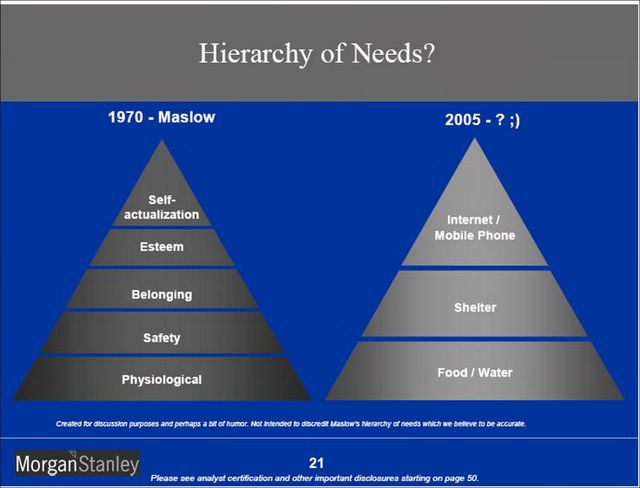
Once in a while, I stumble across something that "just speaks to me." The chart on page 21 of Morgan Stanley's latest Internet Trends research report is a great example.


Source: Morgan Stanley

Monday, September 12, 2005

Network overload

I'm addicted to Web 2.0. My two favorite elements of most Web 2.0 businesses are 1) their syndication platforms and 2) their social networking connections.

The latter attribute, however, is becoming a problem.

Friendster was among the first social networks, and it was a social network for social networking's sake. It didn't have any real functionality. I think that's part of the reason it atrophied (poor performance is another). By the time it tried to become an online dating site, it was too late; users had already started to abandon it in droves.

Eventually, almost every consumer web service will incorporate social networking as a feature. Companies such as Yelp, Trip Connect and Flock serve a valuable function and overlay social networking on top. Yelp is a slick yellow pages. Trip Connect helps with travel planning. And Flock is a new browser. With my social network embedded, I can find out which restaurants or plumbers my friends (and their friends) like on Yelp, which hotels they recommend on Trip Connect, and what web sites and blogs they frequent with Flock (when it launches in the next few months).

The smart incorporation of social networking makes Yelp, Trip Connect and Flock much more powerful than their Web 1.0 counterparts (Superpages, Trip Advisor and FireFox).

The problem, though, is that I will have too many social networks to build and maintain. In addition to Yelp, Trip Connect and Flock, there's LinkedIn for developing new business contacts and GoodContacts or Plaxo for keeping the information in my digital rolodex up to date. I'm building yet another social network of blogs, and the respective bloggers, that I read regularly. Popular blog sites like MySpace and Xanga basically incorporate social networking functionality to facilitate cross-blog interaction.

So, I'm already up to 6 social networks, and I'm sure others will soon emerge.

What I think Web 2.0 needs is an independent social network that individual sites can integrate. Today, I have to invite my friends and colleagues to join each new system that emerges so we can re-establish our personal connections. With an independent overlay, my entire social network would exist in one place and be instantly transportable to new venues.

Since no idea is original, I suspect someone has already started working on a solution to this problem. Now I just need to find it.